No results found, please try a different search term.

The first lever is control
A workplace cannot improve what it cannot see, and many estates still depend on partial data, fixed schedules and legacy assumptions about how buildings behave.
Energy optimisation is often the quickest place to start. For an international banking customer, a multi-year Building Optimisation Programme began in 2022 across 61 sites in 11 countries, using utility data, building controls, plant reviews and site insight to identify practical conservation measures. In its first four years, the programme delivered 45.6GWh in energy savings, £9.2 million in cost savings and 8,396tCO₂e avoided, according to ISS internal case study data.
61
sites in 11 countries
45.6GWh
in energy savings
£9.2m
in cost savings
8,396
tCO₂e avoided
While every facility may not deliver the same numbers, the lesson learnt is that existing buildings often contain avoidable waste before major capital investment is needed.
Some sites can do more than consume
Once energy use is understood, some estates can go further by producing a proportion of their own renewable power.
For a telecommunication customer, ISS supported on-site solar generation as part of a wider workplace energy improvement programme. The installation generates 1,289,700 kWh a year and reduces emissions by 542 tonnes CO₂e annually.
1,289,700
kWh a year
542
tonnes CO₂e annually
That changes how a site is viewed as it becomes part of the organisation’s energy strategy, not simply a source of demand.
Waste is a systems issue
Waste performance is often treated as a bin problem. In practice, it depends on behaviour, segregation, collection patterns, recycling routes and the quality of data behind them.
In one banking sector example, ISS retrofitted 148 waste sensors across two corporate sites. Segregation efficiency improved by 83%, while bins were found to be emptied at 49% capacity, creating opportunities to improve recycling performance, reduce unnecessary collections and strengthen cost control.
148
waste sensors
83%
segregation efficiency improved
49%
capacity
The value is in the visibility, as better data turns waste from a vague environmental concern into an operational performance issue.
The credibility test
A critical eye should be applied to any Net Zero pathway claim. Is the baseline clear? Is the data reliable? Are the outcomes material? Can the progress be repeated across different sites?
Those questions matter because workplace sustainability is strongest when it links environmental progress with operational discipline.
What organisations should ask next
The most useful starting point is a sharper view of the estate itself:
01
Where is energy being wasted?
02
Which sites could produce renewable power on-site?
03
How well are waste streams being segregated, recycled and recovered?
04
Which assets should be repaired before they are replaced?
05
Which FM decisions should include carbon alongside cost?
When those answers are visible, Net Zero becomes easier to manage and. Iit moves from corporate promise to operational practice.
Why Net Zero runs through the workplace
Source: UNEP and GlobalABC, Global Status Report for Buildings and Construction 2025–2026, United Nations Environment Programme, 19 May 2026.

37%
Buildings and construction account for around 37% of global CO₂ emissions, according to UNEP and GlobalABC.

Nearly 50%
The sector is responsible for nearly 50% of global material extraction, according to UNEP and GlobalABC.

What this means for FM
Energy, assets, waste, materials, maintenance and supplier decisions sit close to daily workplace operations. That makes FM a practical route to turn Net Zero ambition into measurable progress.
Credibility starts with transparency
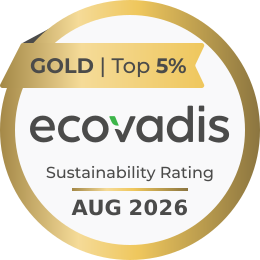
ISS’ 2025 EcoVadis submission achieved a Gold medal, benchmarked against companies in the combined facilities industry.
EcoVadis evaluates companies across four areas: environment, labour and human rights, ethics and sustainable procurement, providing an independent view of how organisations perform against global
standards. Achieving Gold places ISS among the top 5% of all rated companies. Alongside this achievement, ISS has received a B score in the 2025 CDP Climate questionnaire and an A rating for CDP’s Supplier Engagement Assessment, reflecting strong governance, disclosure and action across our value chain.