Most organizations talk about their sustainability efforts in terms of programs, recycling streams or carbon metrics. In day-to-day operations, though, the strongest sustainability drivers are often the ones people barely notice. They exist in the quiet design choices, cultural norms and routines that shape how we behave at work.
Building on the “hidden menu” concept highlighted in a prior blog post, our environment nudges our decisions long before we consciously make them, guiding a hidden sustainability footprint. Instead of just influencing what we eat, this hidden footprint influences our overall health, habits and environmental impact at work.
The Workplace Is Often Our Lowest-Impact Environment
If you measured your personal impact on the planet across a typical day, your footprint is often smallest when you are in the workplace.
Offices run on shared systems that are usually more efficient than what we have at home. Heating, cooling, lighting and water are optimized, maintained and monitored; air filters get changed on a consistent cadence; lighting design supports our comfort and natural circadian rhythms. Even restroom choices, like high-efficiency fixtures or ultraviolet sanitation in hand dryers, can reduce waste and resource use.
Design That Supports Human Rhythms and Well-being
A sustainable workplace goes beyond carbon emissions or recycling — its design supports both the innate patterns of people along with their broader well-being. Movement, lighting, air quality and social connection all contribute to long-term sustainability because they shape how people feel and function.
Movement is a major example. Research from professor of architecture and urban design, Galen Cranz, indicates that humans did not evolve to sit for long, uninterrupted periods. When a workplace encourages people to move through standing-friendly spaces, unassigned seating that keeps people circulating or stair-first design, those small choices add up to healthier daily routines.
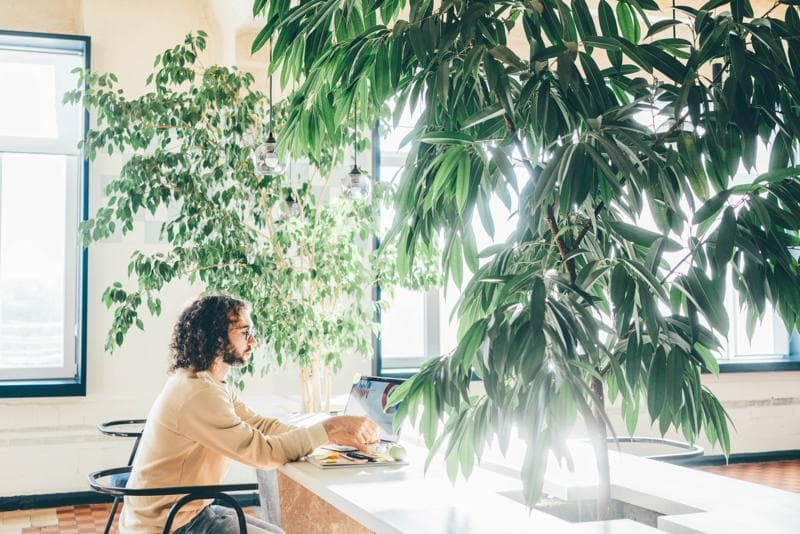
Lighting plays a similar role. Adaptive systems that mimic sunrise, full daylight and evening light help support circadian rhythms. Biophilic elements do double duty, with plant walls, natural materials, outdoor views and landscapes that reflect native ecosystems to support local biodiversity while also making spaces calmer and healthier.
How Workplaces Nudge Sustainable Choices
When sustainability is the desired outcome, design almost always outperforms willpower. Someone may want to recycle more or waste less, but without accessible systems, they’re likely to default to the easiest option; the workplace can remove those barriers.
Shared food environments. Cafés and micro-kitchens reduce the need for employees to buy individually packaged foods, which means fewer single-use containers entering the building. Centralized food programs also run cooking, washing and disposal more efficiently than most homes. In our kitchens, we also use technology such as Winnow to mitigate the amount of food waste we produce.
Optimized waste systems. Clear signage, matched bin sets and high-visibility placement improve diversion rates more reliably than one-off campaigns. Simple, consistent systems work better than relying on individual judgment.
These sustainable behaviors are rarely conscious decisions but are rather enabled by the way the workplace is designed and operated.
Creating a Place of Belonging
Design can also unintentionally work against sustainability. Commuting is a good example.
When companies locate offices far from public transit, they effectively lock in years of car-dependent travel. As a result, employee commutes quickly become one of the largest contributors to an organization’s total environmental impact.
Some employers respond with public transit subsidies, carpool programs, secure bike storage, EV charging or hybrid-working models that reduce the number of long commutes each week. Location and amenities both send strong signals about what is realistic.
Sustainability also relies on how people feel in a space. A workplace that creates belonging, encourages social connection and gives people some control over their environment is inherently more sustainable because people take better care of places they feel ownership over.
Leadership modeling helps, but it is complicated by the realities of executive and sales travel, which often make up a large portion of business-related emissions. In practice, progress tends to come from giving employees tools and choices that make sustainable behaviors easy: reuse programs, community partnerships, access to goods like local produce and events that teach and promote new habits.
Connecting the Workplace to the Community
A sustainable workplace interacts with the community around it. Leaders can invite local partners such as EV dealers, compost operators, solar installers or farmers into the building to share products and services, building community ties and giving employees access to options they might not have at home.
Some organizations bring in local produce boxes or work with farmers to create direct-to-employee programs. Kitchens can pair those with recipes and learning sessions to reduce travel miles, turning the workplace into a hub for sustainable living, not just sustainable business operations.
The Opportunity Ahead
The hidden footprint matters because it reminds us that sustainability doesn’t have to be defined exclusively by massive financial and behavioral commitments. It shows up in the daily, mostly invisible ways people interact with the built environment.
A workplace that supports movement, provides healthy lighting and air, connects people to one another, reduces unnecessary waste and makes sustainable choices intuitive will always outperform one that simply encourages people to “try to make sustainable choices.”
Sustainability works best when it supports people, not the other way around. When we design workplaces that align human needs with environmental goals, we create spaces where people can do their best work and where sustainable behavior becomes the inevitable outcome of a well-designed day.