For years, facilities management has been defined by its technical backbone: maintenance programs, asset lists, capital planning, cleaning standards and streamlined processes. These will always matter, and clients will always expect flawless execution. But the market has changed, along with the needs of corporate real estate teams and the expectations of employees returning to the workplace.
What has not changed is the way most of the industry executes the management of facilities.
Across conversations with clients and leaders preparing for their next phase of workplace strategy, a clear pattern is emerging. Organizations no longer want partners that simply keep buildings operational. They want partners that make their workplaces magnetic — places employees choose to spend time in, not places they are mandated to return to. That shift demands a new narrative for FM, one rooted in hospitality and human-centered service.
The Portfolio Has Changed. Expectations Have Not.
Even before the pandemic, corporate office space was underutilized. Remote work accelerated that trend, leaving many real estate teams responsible for right-sizing portfolios and shedding costly, underutilized assets. What remains today is smaller, more curated and more intentional. And because these spaces now need to deliver a compelling reason for on-site work, the expectations placed on FM providers have become more nuanced.
The technical delivery is assumed. What clients want to understand first is how a partner will shape the employee experience. They want to know not just who is greeting their teams and customers each morning, but also the quality of interactions in their lobbies, collaboration areas, multi-use lounges and food spaces — no matter how modest those spaces may be. They want a partner who understands that employee experiences are impacted by hundreds of daily touch points, many of which fall outside the boundaries of a traditional scope.
This is where FM has an opportunity to evolve.
We Deliver Hospitality Daily, Even If We Don’t Name It
Across our ISS clients, hospitality behaviors are already a major part of our process, from teams that set up all-hands meetings and training rooms, to front-of-house staff who help employees find the right space to work and multi-skilled coordinators who anticipate needs before they arise. These actions rarely appear in formal scopes of work, but they are often the moments that define whether a workplace feels inviting, intuitive and well run.
The challenge is that these behaviors highlight a specific way of working versus a static and unchanging job description.
Sometimes, teams undersell themselves because they assume that if a role isn’t labeled as “workplace experience manager” or “concierge,” then experience delivery is out of scope. Yet clients increasingly evaluate FM partners on exactly these intangible aspects of service: how teams show up, how well they understand culture and how seamlessly they tie individual services into an integrated workplace experience.
An opportunity lies in demonstrating and expressing the work we already do, along with giving our teams the language and structure to talk about it with confidence.
The Modern Workplace Is Flexible and Hospitality-focused
A common misconception in workplace conversations is that hospitality requires large food halls, expansive kitchens or premium concierge desks. In reality, many organizations are moving in the opposite direction. They are reducing oversized café footprints, simplifying back-of-house infrastructure and embracing flexible, multi-use spaces that support collaboration and socialization.
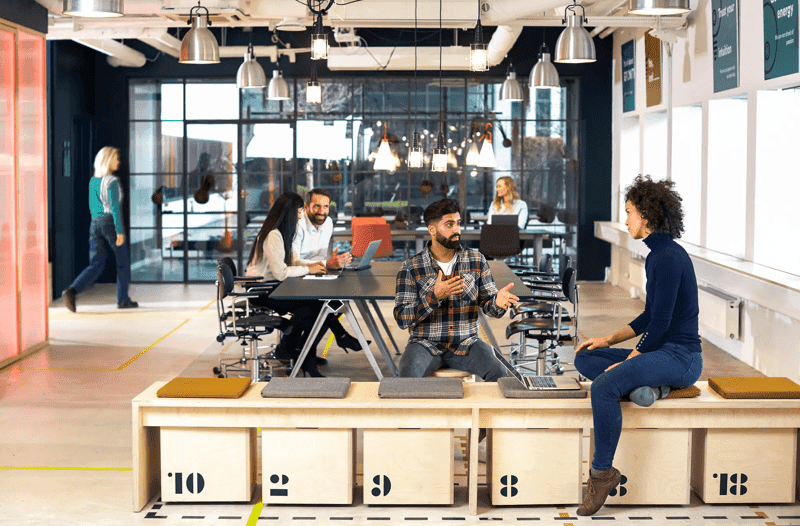
Food is still a cultural anchor, but the definition of a “café” is shifting. Today’s version may be a lounge-like environment with modular seating, ambient biophilia, plug-and-play charging units and space that flexes naturally between heads-down work, customer meetings and team huddles. The hospitality comes from how the space is curated and supported, not just the size of the kitchen behind it.
FM teams play a central role in activation, which deserves to be reflected in how we help determine the requirements of a space.
Experience Is the Present
The organizations leading the next era of FM will be those that leapfrog older approaches by defining experience not as a layer added onto services, but as the ethos that underpins every interaction. Hospitality training provides that ethos, allowing teams to be “off task, on purpose” as needed.
Hospitality unites soft services, technical delivery, food programs, front-of-house roles, event support, space activation and even maintenance into a single, coherent philosophy: every touch point contributes to how people feel at work. And when people feel welcome, supported and understood, culture strengthens and workplaces become destinations.
The next step is to work with the client to build the narrative, tools and proof points that articulate it clearly — especially in sectors where flexibility, culture and experience are central to every core decision.
A Path Forward
To meet this moment, the FM industry must evolve how we frame our value. That evolution includes:
Starting conversations with an understanding of goals for changing how employees experience spaces
Creating new language and metrics to focus on what matters in workplaces today
Elevating examples that show how we can curate daily culture
Defining clear indicators and metrics for hospitality-driven service excellence
Training teams to recognize and communicate the experience elements they already deliver
Re-casting food and front-of-house services as part of a cohesive workplace ecosystem
Above all, it requires shifting from a model that answers, “What services do you need staffed?” to one that begins with “What experience do you want people to have when they walk in the door?”
With experience at the forefront, we can collaborate with clients to find the ideal approach to making their employees feel safe, comfortable and supported in our spaces. And for organizations navigating the realities of always-on work, talent competition and shifting space requirements, it is a welcome and necessary collaboration.